Featured image: Before buying a Panama City Beach condo, investigate the building, association finances, insurance, rental rules and complete ownership cost—not only the Gulf view.
Updated July 22, 2026
What should you know before buying a condo in Panama City Beach? You are buying more than the space inside the unit. You are also buying into the condominium building, association finances, insurance structure, reserve funding, maintenance history, rental rules, parking system and long-term repair obligations.
A renovated condo with a beautiful Gulf view can still be a poor purchase if the building has underfunded reserves, insurance problems, major deferred maintenance or rules that conflict with your plans. Conversely, a higher monthly condominium fee may be reasonable when it supports adequate insurance, reserves, maintenance and valuable services.
The right Panama City Beach condo should fit three things at the same time: how you intend to use it, what you can comfortably afford to carry and the condition of the building behind the individual unit.
Quick buyer checklist
- Define whether the condo is for full-time use, personal vacations, rentals or a combination.
- Calculate the complete monthly and annual ownership cost.
- Review the budget, reserves, meeting minutes, insurance and assessments.
- Request applicable milestone-inspection and structural-reserve information.
- Confirm financing and insurance before the end of your due-diligence period.
- Verify rental, pet, parking and occupancy rules in writing.
- Inspect both the unit and the building’s common areas.
- Evaluate net rental income rather than projected gross revenue.
- Compare the unit with recent sales and current competition inside the same building.
Jump to:Intended use | Ownership cost | Reserves and inspections | Insurance | Financing | Rental rules | Location | Documents | Mistakes | FAQs
1. Decide How You Will Use the Condo Before Touring
Do not begin by choosing a building solely because you like its pool or Gulf view. Begin with your intended use. A condo that works well as a personal second home may not be the strongest rental investment. A high-activity vacation resort may not provide the ownership environment someone wants for full-time living.
Intended use | Important considerations | Common conflict |
|---|---|---|
Full-time residence | Noise, elevators, parking, storage, pets, owner occupancy and daily convenience | Heavy guest turnover and limited storage |
Personal second home | Lock-and-leave convenience, owner access, furnishings and maintenance | Carrying costs during long periods without use |
Vacation rental | Rental eligibility, guest demand, parking, management and operating expenses | Rules or expenses that reduce potential net income |
Mixed personal and rental use | Owner-use dates, rental seasonality, management agreement and tax advice | Using the condo during its strongest rental periods |
Tell your Realtor, lender and insurance agent exactly how the property will be used. Personal use, second-home financing and investment-property use can affect building selection, loan requirements, insurance and financial analysis.
2. Calculate the True Cost of Condo Ownership
The purchase price is only the beginning. A realistic Panama City Beach condo budget may include:
- Mortgage principal and interest
- Monthly condominium or association fees
- Property taxes
- Unit-owner insurance
- Flood coverage when applicable
- Utilities not included in the association fee
- Internet and cable when not included
- Interior maintenance and repairs
- HVAC, water heater and appliance replacement
- Furniture and household-item replacement
- Parking, registration or amenity charges
- Special assessments
- Rental management and operating expenses
- A personal reserve for unexpected costs
Read my detailed guide to HOA fees for Panama City Beach condos before comparing buildings.
A low fee is not automatically a bargain
Low association fees can be attractive, but buyers need to understand why the fee is low. Is the building efficient and well funded, or has maintenance been postponed? Does the fee include insurance, water, internet, cable or other expenses you would otherwise pay separately?
A higher fee is not automatically bad either. The useful comparison is the fee, what it covers, the condition of the building, reserve funding and the likelihood of additional assessments.
3. Review Reserves, Assessments and Building Inspections
This is now one of the most important parts of buying a Florida condominium. Buyers should ask for available information about reserve funding, major repairs, inspection results and anticipated projects.
Florida’s Department of Business and Professional Regulation explains that qualifying condominium and cooperative buildings three stories or higher are subject to structural-integrity reserve study requirements. A Structural Integrity Reserve Study, commonly called a SIRS, is intended to evaluate reserve needs for designated building components.
A milestone inspection and a SIRS are not the same thing. A milestone inspection addresses the building’s structural condition. A SIRS addresses reserve planning and funding for specified components. Some buildings may be subject to both requirements.
Because requirements, deadlines and individual-building circumstances can vary, buyers should review the association’s actual reports and obtain appropriate legal, engineering or financial advice. Start with the official Florida DBPR condominium inspection resource and DBPR condominium FAQs.
Questions to ask about reserves and repairs
- Has the building completed a SIRS, if applicable?
- Has it completed an applicable milestone inspection?
- Did either report recommend repairs or further investigation?
- How much money is currently held in reserves?
- How does current funding compare with the study’s recommendations?
- Have association dues increased recently?
- Are additional increases being discussed?
- Are there current, approved or proposed special assessments?
- Which owner will be responsible for an assessment at closing?
- Are large projects planned for balconies, elevators, roofing, waterproofing, windows, parking structures or exterior coatings?
Florida condominium law changes over time. Buyers who want to review the controlling law can consult Chapter 718 of the Florida Statutes and obtain advice from a qualified Florida attorney.
4. Investigate Both Association and Unit-Owner Insurance
Condominium insurance has two major parts: the association’s master policy and the coverage purchased by the individual unit owner. Do not assume the master policy covers everything inside your condo.
Ask for current master-policy information and discuss it with an insurance professional who understands coastal Florida condominiums. Questions may include:
- Which structures and common elements does the master policy cover?
- What are the wind, hurricane and other deductibles?
- Are there exclusions or coverage limitations?
- Does the association appear to carry the coverage required by the governing documents and lender?
- What interior components and personal property must the owner insure?
- Will rental activity require different or additional owner coverage?
- Is loss-assessment coverage available or appropriate?
- Will the lender require flood insurance?
Get a property-specific insurance estimate before your due-diligence deadline. A quote for another unit or another building is not a substitute.
5. Make Sure the Building Can Be Financed
Condo financing involves both the borrower and the project. A financially qualified buyer can still encounter problems if the building does not satisfy a lender’s condominium-project standards.
Depending on the loan program and building, a lender may review items such as:
- Association budgets and reserve funding
- Master insurance coverage
- Building condition and deferred maintenance
- Special assessments
- Pending litigation
- Commercial space or hotel-like operations
- Owner-occupancy and investment concentration
- Delinquent association accounts
- Single-entity ownership concentration
Fannie Mae maintains formal condominium project review requirements. Your lender—not the seller or listing description—should determine whether a particular building and loan meet current requirements.
Practical tip: Ask your lender to begin researching the building early. Do not wait until the final days of the financing period to discover a project-level issue.
6. Evaluate the Individual Unit and the Building Separately
A beautiful renovated unit does not repair an underfunded association. A well-run building does not make an overpriced or poorly positioned unit a good purchase. Score the unit and building separately.
Evaluate the unit | Evaluate the building |
|---|---|
Floor plan and usable space | Association finances and reserves |
Floor height and view direction | Insurance and assessment exposure |
Interior updates and condition | Roof, exterior, balconies and waterproofing |
HVAC, water heater and appliances | Elevators, parking and common areas |
Noise, privacy and elevator proximity | Rental, pet, occupancy and guest rules |
Furniture and owner storage | Management, security and maintenance quality |
7. Verify Short-Term Rental Rules in Writing
Do not assume a unit allows vacation rentals simply because other condos in the building appear on rental websites. Rental eligibility may be affected by:
- The declaration of condominium
- Association bylaws and rules
- Minimum rental periods
- Guest-registration procedures
- Occupancy limits
- Parking restrictions and fees
- Owner and guest pet rules
- Local licensing or registration
- Insurance requirements
- Existing rental-management agreements
The City of Panama City Beach states that qualifying vacation rentals inside city limits require a valid Vacation Rental Certificate. Properties outside the city may be governed by different county requirements. Review the city’s official short-term rental information and my Panama City Beach short-term rental buyer guide.
Gross rental revenue is not profit
For an investment condo, build a realistic worksheet:
Potential gross rental revenue
Minus management, platform and reservation costs
Minus association fees, taxes and insurance
Minus utilities, internet and owner-paid services
Minus cleaning, repairs, supplies and replacement items
Minus furnishing, appliance and capital-repair reserves
Minus owner-use dates and periods without reservations
= Potential net operating income before financing and income taxes
Past income and projections do not guarantee future performance. Review actual statements when available, identify unusual one-time income or expenses and compare the unit with competing rentals in the same building.
For more investment research, read Is Panama City Beach a Good Place to Buy Investment Property?
8. Compare Location, Building Density and Daily Convenience
Panama City Beach buildings can offer very different ownership experiences even when they are only a few miles apart.
- Pier Park and the west end: Walkability, dining, shopping and recognizable vacation-rental locations.
- Central Front Beach Road: Access to attractions, restaurants and a large selection of resort buildings.
- Thomas Drive and the east end: Access toward Grand Lagoon, marinas, restaurants and St. Andrews State Park.
- Lower-density buildings: Potentially fewer units sharing elevators, parking and amenities, but possibly fewer services.
- Large resort buildings: Extensive amenities and recognition, but potentially more guests, elevator use and common-area maintenance.
Buildings buyers frequently compare
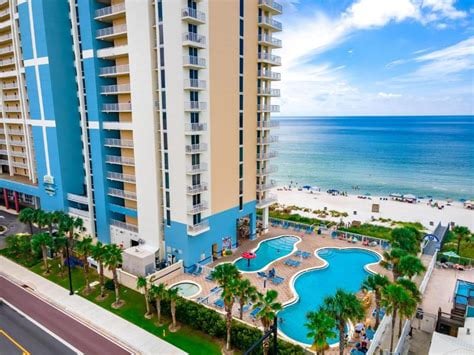
- Calypso Resort & Towers — Beachfront location near Pier Park
- Tidewater Beach Resort — Large west-end resort with multiple amenities
- Majestic Beach Resort — Central beachfront towers and resort facilities
- Sterling Reef — Gulf-front building near M.B. Miller County Pier
These examples are not a ranking. The best building depends on intended use, budget, unit position, association condition, insurance, rental rules and total ownership cost.
9. Inspect Parking, Elevators and Access
Parking and elevators can have an outsized effect on both personal enjoyment and guest satisfaction. During a showing, determine:
- Whether parking is deeded, assigned or first come, first served
- Whether the garage is attached or across the street
- Whether a skybridge or street crossing is required
- Maximum vehicle height
- Owner and guest registration procedures
- Availability of additional parking passes
- Rules for motorcycles, trailers, golf carts and oversized vehicles
- Number and location of elevators
- Distance from parking to the unit
- Elevator congestion during busy arrival and departure periods
A building can look convenient during a quiet weekday but feel very different on a summer Saturday. If possible, visit during a busy period before purchasing.
10. Documents to Request and Review
Available documents and their timing can vary by transaction, but buyers should ask about:
- Declaration of condominium and amendments
- Articles, bylaws and current association rules
- Current operating budget
- Recent financial statements
- Reserve schedules and applicable reserve studies
- Applicable milestone-inspection information
- Recent board and owner meeting minutes
- Master insurance information
- Current, approved or proposed assessment notices
- Pending litigation disclosed by the association or seller
- Rental, parking, pet and occupancy policies
- Frequently asked questions or association disclosure forms
- Available building maintenance and repair information
- Seller’s disclosure and unit-specific repair history
A Realtor can help obtain and organize available information, but legal interpretation should come from a qualified attorney. Engineering questions should go to the appropriate engineer, insurance questions to an insurance professional and tax questions to a qualified tax adviser.
Use my Beachfront Condo Realtor Checklist to organize the investigation before touring, offering and closing.
Common Panama City Beach Condo-Buyer Mistakes
Looking only at the Gulf view
The view affects value, but it does not replace financial, structural and insurance due diligence.
Assuming the lowest HOA fee is best
Compare what the fee covers, reserve funding, maintenance, insurance and assessment exposure.
Waiting too long to investigate insurance
Obtain property-specific information during the due-diligence period, not immediately before closing.
Trusting a rental projection without examining expenses
Gross revenue can look impressive while net income is disappointing after all ownership and operating costs.
Assuming every unit in the same building is equal
Floor height, view direction, stack, parking, elevator proximity, updates, furniture and rental history can materially affect value.
Ignoring meeting minutes
Minutes may identify repairs, insurance discussions, owner concerns and possible assessments that are not visible during a showing.
Skipping an independent unit inspection
The association maintains many common elements, but the buyer still needs to understand the condition of the unit and owner-maintained components.
Changing lenders late in the transaction
A new lender may have to restart the building review and may apply different condo-project requirements.
Frequently Asked Questions
Are Panama City Beach condos a good investment?
Some can be, but performance depends on purchase price, building condition, association finances, rental rules, view, unit condition, management, competition and complete operating expenses. Evaluate potential net income rather than gross revenue alone.
How much are Panama City Beach condo HOA fees?
Fees vary significantly by building, unit size, amenities, insurance and what is included. Compare the fee with the association’s financial condition, reserves, building maintenance and services—not as a stand-alone number.
Can every Panama City Beach condo be used as a vacation rental?
No. Short-term rental eligibility may depend on association documents, building rules, the property’s jurisdiction, licensing, insurance and management requirements. Verify the exact unit and current rules in writing.
What is a special assessment?
A special assessment is an additional charge levied against owners outside the regular adopted budget. Assessments may fund repairs, insurance costs, reserve needs or major projects. Confirm current assessments and determine how the purchase contract assigns responsibility.
What is a Structural Integrity Reserve Study?
A SIRS evaluates reserve needs for designated components of qualifying Florida condominium and cooperative buildings. It is different from a milestone inspection, which focuses on structural condition. Review the actual reports applicable to the building.
Do I need an inspection when buying a condo?
An independent unit inspection is generally prudent. Buyers should also investigate the building’s condition, association records and applicable engineering or inspection reports. A unit inspection does not replace building-level due diligence.
Why can a lender reject a condo building?
Lenders may identify issues involving insurance, reserves, assessments, litigation, deferred maintenance, ownership concentration or other project standards. Ask the lender to begin its building review early.
Is a cash purchase safer than financing?
Cash removes lender approval from the transaction, but it does not remove building, insurance, structural, rental or resale risk. Cash buyers should still conduct complete due diligence.
Which Panama City Beach condo building is best?
There is no single best building. The right choice depends on intended use, budget, location, desired amenities, ownership cost, rental plans, building finances and the position of the individual unit.
Where can I search current Panama City Beach condos?
Start with the Panama City Beach condo search and buyer guide or browse current homes and condos for sale.
Work With a Panama City Beach Condo Realtor
Buying a beachfront condo requires more than opening doors and admiring views. The building, association, insurance, rental rules, assessments, unit position and total ownership cost all need to be investigated.
Roger Rietsema is a Realtor® with Allison James Estates & Homes serving Panama City Beach and 30A. His real estate experience and work as a co-owner of Emerald Beach Rentals help buyers ask practical questions about vacation-rental operations, maintenance, guest use, management and the difference between projected gross revenue and potential net income.
Explore Panama City Beach condos
Search current listings
Contact Roger Rietsema
Call or text: 850-596-5844
This article provides general real estate information and is not legal, engineering, insurance, lending, accounting or tax advice. Condominium rules, laws, fees, reserves, insurance, assessments, rental policies and financing requirements can change. Buyers should independently verify all information important to their purchase with the association and appropriate qualified professionals.